The right bulk bag. The first time.
Since 1947 we have engineered, stocked and supported the FIBCs that move our customers’ bulk — grain, minerals, chemicals, food. Not just a bag: the right bulk handling solution, made and warehoused in Canada.
Build my bulk bagTalk to an expert
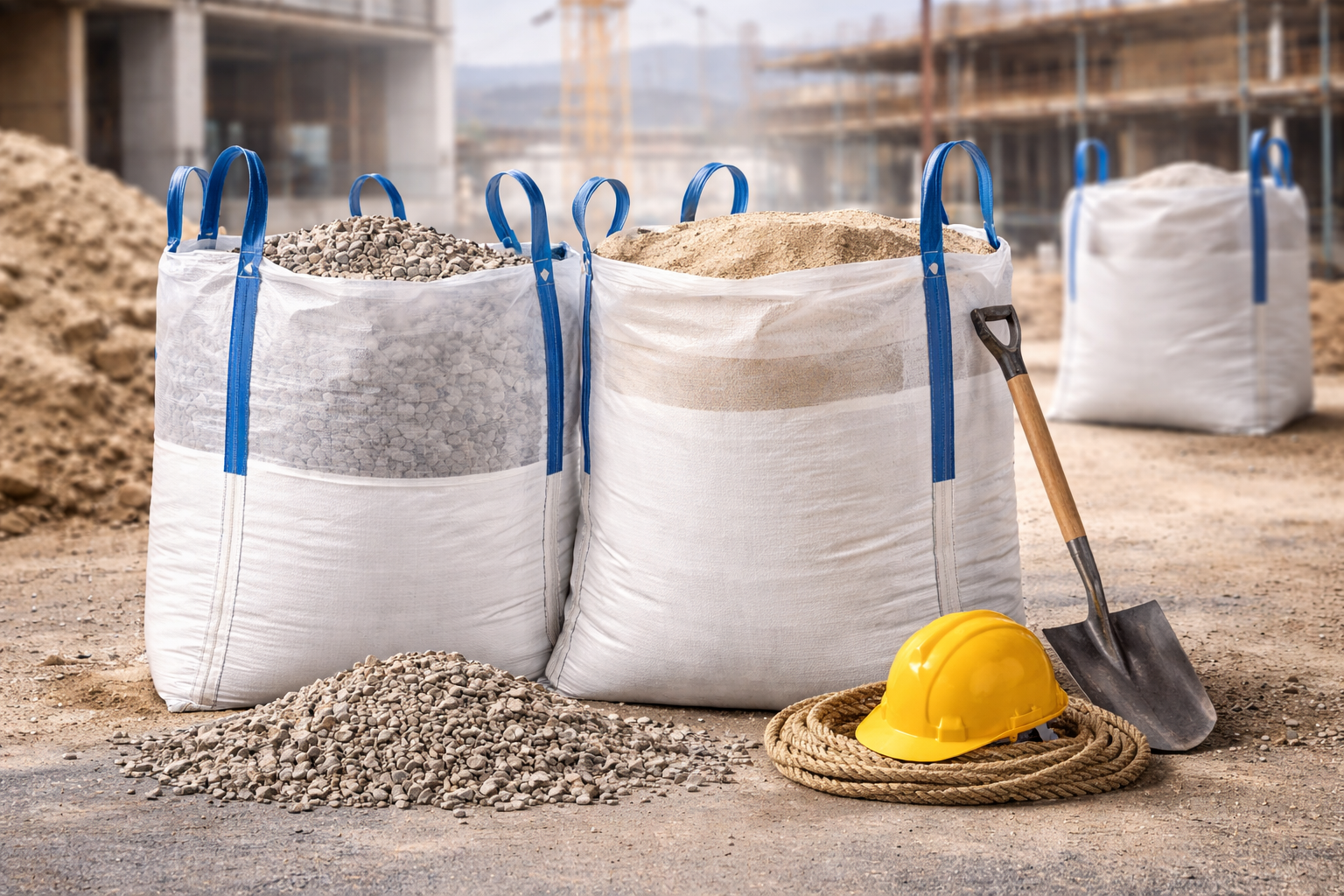
FIBC, bulk bag, big bag: same bag, different name
The same product goes by a different name depending on who you ask, which makes it hard to search for. FIBC is the technical acronym: Flexible Intermediate Bulk Container. On a North American plant floor it is usually a bulk bag, or a super sack — a trademark that became a common noun, the way Kleenex did for tissue. European suppliers and international trade documents say big bag. In French-speaking Quebec, where our plant is, it is a sac conteneur.
One tonne of material, a dozen names. Use whichever term you know when you call us — we will follow.
FIBC selection assistant
Answer five questions and we assemble the recommended build — attach it as-is to your quote request.
1. What are you shipping?
2. Approximate bulk density
3. Filling (top)
4. Discharge (bottom)
5. Does your product require…
Volume calculator
Enter the dimensions of your bag, hopper or pallet footprint. Work in inches, centimetres or millimetres, pick your answer unit, then calculate.
The FIBC guide
Want to understand before you order? Our technical notes, written by people who have been building these bags since 1947.
Type A, B, C and D — electrostatic safety, explained
Combustible powders, solvents, explosive atmospheres: the wrong FIBC type is a genuine plant hazard. Here is the classification, in plain English.
Type A
No electrostatic protection. For non-flammable products, with no solvents or explosive atmosphere nearby.
Type B
Limits high-energy propagating brush discharges (breakdown voltage under 6 kV). For dry flammable powders, no solvents present.
Type C
Conductive fabric bonded to ground during filling and discharge. The standard where flammable gases or vapours are present — grounding is mandatory.
Type D
Static dissipative fabric: protects without grounding. The answer when a reliable ground connection cannot be guaranteed on the floor.
Not sure which type your process needs? That is exactly the call we take every day — talk to us before you order.
Anatomy of an FIBC
Every component is selected around your product, your equipment and your throughput.
- Lift loops — sewn into the body seams; 1, 2 or 4-point lift to match your forklift or hoist.
- Fill spout or duffle top — matched to your hopper; duffle for fast closure, spout for clean filling.
- Woven body — high-tenacity polypropylene, coated or uncoated; U-panel, circular or 4-panel with baffles.
- Inner liner — PE or food grade, for moisture barrier, product protection or direct food contact.
- Discharge spout — with tie cord and protective flap; or flat bottom, or full open discharge.
Built for your industry
From seed to aggregate, the right build depends on the product — and we know them all.
Why Sacs Industriels
📦 Canadian inventory
A deep selection warehoused in LaSalle, Quebec. No 8-to-12-week ocean wait: stock bags ship fast, and custom builds follow in production.
🧠 Engineering input
SWL, safety factor, electrostatic type, liner spec — we size the bag around your real filling, lifting and transport constraints.
🪡 In-house sewing floor
Three generations of industrial textile know-how since 1947 — repairs, adaptations and custom-sewn products under our own roof.
🤝 A real person on the phone
514-481-2713. An expert who knows your product, not a call centre. Fast quotes, in English or French.
Request a quote — it is easy
Send us your product, target load and quantity. A specialist gets back to you with a build recommendation and pricing.
What customers actually ask us
These are the questions we get on the phone, in the words people use. Straight answers.
Where can I buy FIBC bulk bags near Montreal?
From us. Our warehouse and finishing shop are in LaSalle, on the island of Montreal, and have been since 1947. The bags themselves are produced by long-standing partner mills; we hold the inventory here, and printing and finishing are done in our own shop. For you that means short lead times on standard sizes and someone to call in Montreal rather than a supplier on the other side of the world.
How much does a bulk bag cost?
There is no single price, and be wary of anyone who quotes one without asking questions. Cost depends on order volume, the load it must carry (the SWL), fabric weight, whether it needs a liner, the number of spouts, printing, and the electrostatic type (A, B, C or D). A plain unlined bag and a printed Type C for combustible powder are not in the same price bracket. Tell us the material, the weight and how you fill it, and you will get a firm number.
New versus reconditioned FIBC — what is the difference?
A new bag carries a traceable load certificate and has never held anything. A reconditioned bag has been used, cleaned and inspected, and costs less — but its history limits where it can go. For food, pharmaceutical and anything involving electrostatic safety, start with new. For fill, waste or in-plant transfer, reconditioned makes good sense.
Can a bulk bag be reused?
It depends on the safety factor printed on the label. A 5:1 bag is built to be reused; a 6:1 bag is single-trip. Reusing a 6:1 means spending the safety margin it was engineered with. When in doubt, the sewn-in label decides — not how the bag looks.
Which FIBC for flour, plastic pellets or sand?
Three materials, three answers. Flour is a fine food-grade powder: food-grade liner, and mind the electrostatic type if the product is combustible. Plastic pellets flow well but build static charge: the right type depends on your equipment and the zone classification. Sand is heavy and abrasive: SWL and fabric strength drive the choice, and a liner is rarely needed. Describe the material and we will settle it.
What does an empty bulk bag weigh?
Only a few kilograms for a common size — the number that matters is what it can carry, typically 1,100 to 4,400 lb depending on construction. Tare weight matters for freight calculations and for manual handling before filling; ask us for the exact size you have in mind.
How do I read an FIBC label?
Three things matter. SWL (Safe Working Load): the maximum load in service. The safety factor (5:1 or 6:1): the strength margin, and therefore whether you may reuse it. The type (A, B, C or D): electrostatic behaviour. The rest — dimensions, lot, date — is traceability. Our FIBC guide covers each one.
Do you ship outside Quebec?
Yes, anywhere in Canada. For recurring orders we set up replenishment agreements so you are never caught short between production runs.
Bulk bags in your industry
A bulk bag is not chosen the same way depending on what goes in it. Here is how it is used across the industries we serve.
Frequently Asked Questions
What FIBC shapes do you offer?
U-panel, circular and 4-panel with baffles, with or without liner, depending on your product and handling equipment.
Do you keep bulk bags in stock?
Yes — a deep selection is warehoused in Canada for fast delivery, and custom builds are produced to order.
How do I choose the right bulk bag?
Tell us your product (grain, minerals, sand, chemicals) and your filling, lifting and transport constraints: we recommend the fabric, liner and configuration.
What is SWL and the 5:1 safety factor?
SWL (Safe Working Load) is the maximum working load of the bag. A 5:1 safety factor means the bag is tested to withstand five times its SWL; certified multi-trip bags are built to 6:1.
What is the difference between Type A, B, C and D bags?
It is the electrostatic classification: Type A has no protection, Type B limits high-energy discharges, Type C is conductive and must be grounded, Type D is static dissipative and needs no ground. The right choice depends on your product and working atmosphere.
Do you supply food grade FIBCs?
Yes, with liners and constructions suited to direct food contact. Tell us the application in your quote request and we will recommend the right build.
Are bulk bags reusable?
Standard 5:1 bags are designed for single trip. Multi-trip bags built to a 6:1 safety factor are available — tell us your use cycle.
What volume and weight can an FIBC hold?
Commonly 1,000 to 4,400 lb depending on product density, with typical footprints of 35 x 35 to 40 x 40 inches and heights from 40 to 70 inches.